Guide · Drawing
Still life drawing: what a still life is, and how to set one up and draw it
A still life is a picture of objects that don’t move: fruit, flowers, food, cups, bottles and other everyday things. Still life drawing means drawing such an arrangement from life, usually under a single light, and artists have long used it to practise observation, proportion and shading. Elena Ant sets still lifes under a directed light for her students in London, Ontario.
What is a still life?
A still life is a work of art whose main subject is inanimate objects, such as fruit, flowers, food and everyday things. It can be painted, drawn, photographed or sculpted.
The National Gallery in London describes still lifes as paintings in which inanimate objects, such as fruit, flowers, food and everyday items, are the main focus of interest (National Gallery, London (opens in a new tab)). The Tate puts it more simply: the subject of a still life is anything that does not move or is dead (Tate (opens in a new tab)).
Still lifes may be painted, drawn, photographed or sculpted (Getty (opens in a new tab)).
The English term comes from the Dutch stilleven, which came into use around 1650. In French, still-life painting was later called natures mortes (National Gallery, London (opens in a new tab)).
Where does still life painting come from?
Paintings of objects go back to ancient Egyptian tombs and Roman wall paintings, but still life first flourished as an independent genre in the Netherlands in the early 1600s.
Still life is found from ancient Egyptian tombs, decorated with paintings of objects from daily life, to modern art (Getty (opens in a new tab)). A Roman fresco of peaches and a water jar from Herculaneum, painted around 62 to 69 CE, belongs to a kind of still life called xenia, after the Greek word for hospitality (Smarthistory (opens in a new tab)).
Still-life painting first flourished as an independent genre in the Netherlands in the early 1600s (The Met (opens in a new tab)). Still lifes about decay and the futility of worldly life were especially popular there in the 17th century, and are known as vanitas or memento mori (National Gallery, London (opens in a new tab)).
The French Academy’s hierarchy of genres, set in the 17th century, ranked still life last, after history painting, portraiture, genre painting and landscape, because it did not involve people (Tate (opens in a new tab)).
Paul Cézanne painted the same objects, a green vase, a rum bottle, a ginger pot and apples, over and over for the last thirty years of his life (Getty (opens in a new tab)).
Why do artists draw still lifes?
Because the artist chooses the objects and the light, and the objects stay still. Still life is a long-standing way to practise observational drawing, measuring proportions, shading and composition.
Artists have long used the still life to practise observational drawing and sighting, and to master shading to build volume, positive and negative space, and balanced composition (Palomar College (opens in a new tab)). It is good practice in making several objects relate to one another in proportion and composition (DeRoche, 2022 (opens in a new tab)).
Light and shadow change when the light changes, so many artists draw under controlled light, such as a still life set up indoors with a single light source (Palomar College (opens in a new tab)). A still life also needs no model and no trip to a landscape (Getty (opens in a new tab)).
For a still life, Elena Ant sets objects under a directed light that shows the boundary between light and shadow, the cast shadows, the form shadows and the direction of the light. Students start with a linear drawing, then build the volume.
How do you set up a still life to draw?
Choose a few objects of different sizes, shapes and textures, place them so that some overlap, against a plain paper or fabric backdrop, and light them from one side with a single lamp.
A single light, preferably from the side, creates a clear pattern of lights and darks that helps define the forms and how the objects relate to each other (Palomar College (opens in a new tab)).
Gather objects of various sizes, textures and values, limited to one or two colours, and place them so that some overlap, which shows what is in front and adds a sense of space. A sheet of paper or fabric makes the backdrop (Palomar College (opens in a new tab)).
For a first observational drawing, one or two simple geometric objects, such as a cube and a sphere, are enough (Palomar College (opens in a new tab)). Elena Ant also starts beginners with the volume of a sphere and a cube.
Whether you sit or stand, keep the same position, so that you always see the still life from the same place (Palomar College (opens in a new tab)).
What are the parts of light and shadow in a still life?
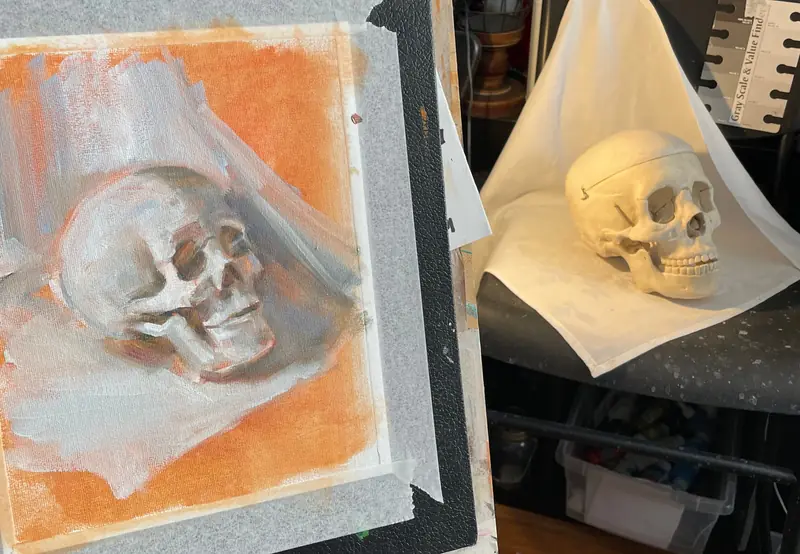
Highlight, light, shadow, core shadow, reflected light and cast shadow. Together they make an object look solid, and they show where the light comes from.
A teaching textbook from Palomar College names the elements of light as highlight, light, shadow, core shadow, reflected light and cast shadow (Palomar College (opens in a new tab)).
The highlight is the lightest part of an object, where its surface faces the light most directly. The light is the part that faces the light source. The core shadow is the darkest part of the object, because it receives no light (Palomar College (opens in a new tab)).
Reflected light is light bounced from a nearby surface into part of the shadow, and it is never as strong as direct light. A cast shadow is darkest right under the object, and a hard light gives it a sharp edge (Palomar College (opens in a new tab)).
The balance and pattern of light and shade in a painting or drawing is called chiaroscuro, Italian for light-dark (Tate (opens in a new tab)).
How do you draw a still life, step by step?
Frame the picture, measure the objects by sighting along a pencil held at arm’s length, block in their shapes with light lines from general to specific, then add tone, keeping the darkest shading and fine detail for the end.
Frame your subject first, and find the ratio of its height to its width with a viewfinder or your pencil (DeRoche, 2022 (opens in a new tab)).
To measure, hold the pencil at arm’s length with your elbow locked, so that it is always the same distance from your eye, and close one eye: with one eye closed, angles and lengths are easier to compare (Palomar College (opens in a new tab)).
Block in the shapes of the objects with simple lines and no detail, and work from general to specific rather than finishing one area at a time (Palomar College (opens in a new tab)). Keep the first lines light, so that mistakes are easy to fix (DeRoche, 2022 (opens in a new tab)).
The rims of cups and bottles are ellipses. Draw each one as a continuous curve, because stopping at the ends turns them into points (DeRoche, 2022 (opens in a new tab)). Below eye level you see the top of an ellipse, at eye level it flattens into a line, and above eye level you see its bottom (DeRoche, 2022 (opens in a new tab)), as in perspective drawing.
Then switch to a darker pencil for the middle greys, and add the darkest shading and fine details at the end, once their places are settled (DeRoche, 2022 (opens in a new tab)).
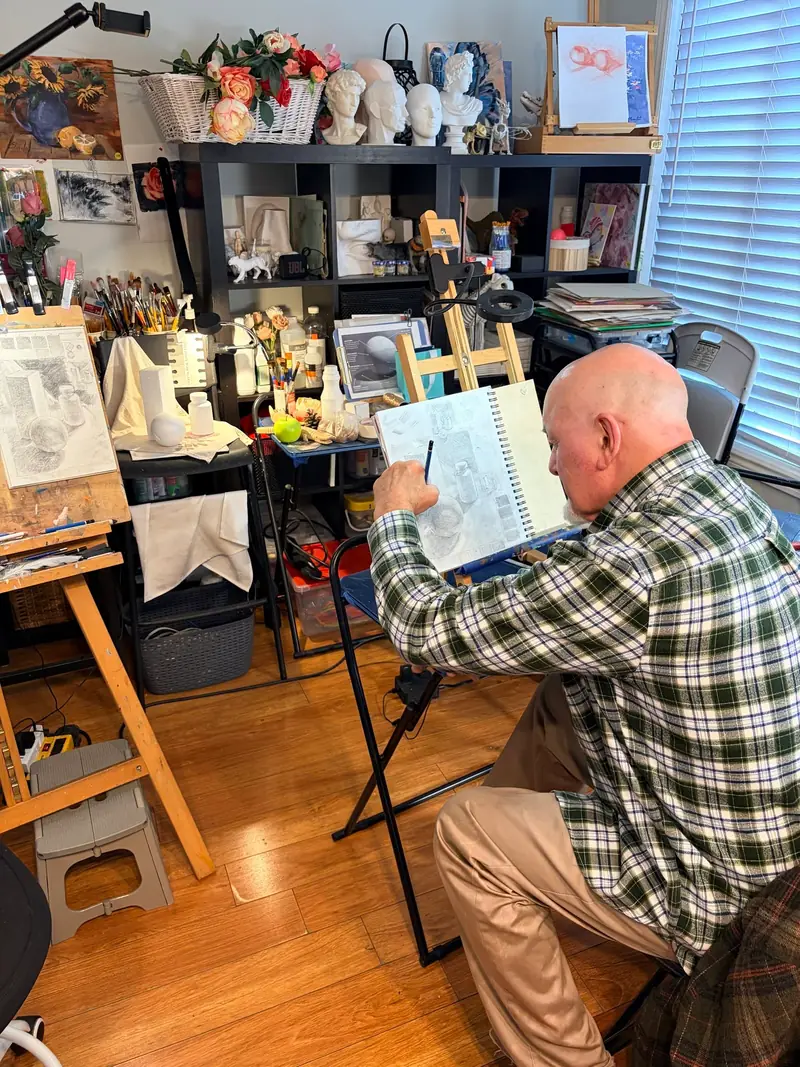
In Elena Ant’s lessons, she demonstrates each stage at her own easel and checks every student’s work after it. At the end, students step back a metre and a half to two metres to judge their drawing.
Do art schools ask for still life drawings?
Some Ontario programmes do. OCAD University suggests including drawing from direct observation, such as still life, and Sheridan College’s sample Illustration drawing test asks for a still-life composition.
OCAD University’s portfolio tips suggest including examples of drawing from direct observation, such as figure drawing, still life, interiors and landscapes (OCAD University (opens in a new tab)).
Sheridan’s sample drawing test for its Bachelor of Illustration asks applicants to arrange three objects into a still-life composition, and every drawing in the test must be drawn from life (Sheridan College (opens in a new tab)).
Still life drawing classes in London, Ontario
Elena Ant teaches children from age seven, teenagers and adults at her studio, in groups of at most six or one to one. Students draw still lifes from life under a directed light, and build volume from the sphere and the cube.
Ask Elena Ant about a place in a class
Tell her which class you are interested in. Groups take at most six students.