Research · Children and teenagers
The benefits of art for kids and teens: what research shows
Drawing and painting lessons give children a real skill and the habits that come with it: looking closely, judging their own work, and sticking with something hard. Studies also find that drawing lifts a child’s mood, goes with higher self-esteem, and helps people remember what they learn.
In short
- 5 minof drawing lifted children’s mood after a disappointment, most when they drew something else, in experiments with children aged 6 to 12. (Drake, 2021 (opens in a new tab))
- 6,209UK eleven-year-olds: those who drew, painted or made things most days had higher self-esteem. (Mak and Fancourt, 2019 (opens in a new tab))
- 3 weekslater, university students still remembered course terms they had drawn better than terms they had copied out. (Jalava et al., 2023 (opens in a new tab))
- OECDreview: the main reason to learn art is the skill itself and the habits it builds, from looking closely to sticking with something hard. (Winner et al., 2013 (opens in a new tab))
What do children get from art lessons if they never become artists?
A real skill, learned step by step, and the habits of mind that come with it. An international review of arts education concluded that this is the main reason to teach art.
The review, published by the OECD in 2013, defines artistic skills as “not only the technical skills” of painting and drawing “but also the habits of mind and behaviour that are developed in the arts” (Winner et al., 2013 (opens in a new tab)).
It draws those habits from a study in which researchers filmed 38 visual-art classes at two arts schools in the Boston area and asked the teachers what they meant to teach. Four of them:
- Observe: looking more closely than usual, “to see with new eyes”.
- Envision: imagining what the eye cannot see, such as the structure inside a form.
- Reflect: stepping back to judge one’s own work.
- Engage and persist: staying with a task for a long time, and learning “how to work through frustration”.
Elena Ant’s lessons are built around the same things. Students draw still lifes from life under a directed light, build volume from the sphere and the cube, and at the end of each lesson step back a metre and a half to two metres to judge their own work. Teenagers take the same habits further in academic drawing: perspective, form, tone and composition, drawn from observation. She asks every student to focus on the process, not on each result.
Some parents bring their children so they are busy with something other than computer games, and so they learn art from an early age. Some children later show a serious interest, and she talks with them about careers in art and design.
“Their job is not to judge the result. It is to focus on the process of becoming an artist.”
Does drawing help children cope with difficult feelings?
Yes. In experiments, a few minutes of drawing lifted children’s mood after a disappointment, most of all when they drew something other than what upset them.
In two experiments in the United States, children aged 6 to 12 recalled a disappointing event and then drew. Their mood improved more when they drew something unrelated than when they drew the disappointment itself, and the benefit came from making their own picture rather than copying someone else’s (Drake and Winner, 2013 (opens in a new tab)).
In three later studies, with 130, 231 and 81 children aged 6 to 12, children drew for five minutes. Drawing to distract was more absorbing and enjoyable than drawing the sad event, and when children were free to choose, more than nine in ten drew something unrelated to their sadness. The author concluded that “a single session of drawing improves mood in children” (Drake, 2021 (opens in a new tab)).
A study in France with 66 seven-year-olds and 72 ten-year-olds concluded that drawing “can be used as a reliable emotion regulation technique with children”. How well it worked depended on how competent children felt at drawing, not on their actual drawing skill (Brechet et al., 2022 (opens in a new tab)).
Is art good for children’s self-esteem?
Children who draw and paint often tend to have higher self-esteem, according to a large UK study.
Researchers compared 6,209 eleven-year-olds in the UK Millennium Cohort Study, matching children on family background and other factors. Those who drew, painted or made things most days had higher self-esteem than those who did so less often, and the gap was more than twice as large against children who rarely or never did (Mak and Fancourt, 2019 (opens in a new tab)).
It did not seem to matter how good the children were at art.
Elena Ant does not criticise children’s work, and she asks parents not to: young artists are very sensitive to criticism, and every stage of their development matters. A child joining a group that has already started begins with individual classes, to get used to her, learn to concentrate, and lose the nervousness and self-criticism.
Does drawing help children learn and remember?
Drawing something is one of the most effective ways to remember it, and sketching while reading helps students understand science texts.
In laboratory studies at the University of Waterloo, mostly with young adults, people remembered words and definitions they had drawn better than ones they had written out, visualised or even traced (Fernandes et al., 2018 (opens in a new tab)).
In an introductory university biology course, 145 students drew or copied out definitions of course terms. One week and three weeks later, they remembered the terms they had drawn better, without any drawing training (Jalava et al., 2023 (opens in a new tab)).
A review of research on learning by drawing found that drawing what you read in a science text is consistently more effective than only reading or summarising it (Fiorella and Zhang, 2018 (opens in a new tab)).
In a study of 73 seventh-graders reading about the greenhouse effect, among students who used their strategy well, those who sketched learned clearly more than those who wrote explanations, and better sketches went with better learning (Scheiter et al., 2017 (opens in a new tab)).
How does art help children at school?
In a large randomised trial, more arts education led to better writing scores and fewer discipline problems, and studies link visual art with stronger geometric reasoning and sharper observation.
In a randomised trial in 42 schools in Houston, Texas, students given more experiences in the arts, from theatre and music to visual art and dance, had fewer discipline problems, better writing scores and more empathy (Bowen and Kisida, 2023 (opens in a new tab)).
The OECD review reports that students who study visual art are stronger in geometrical reasoning, and that in one experiment, learning to look closely at works of art seemed to improve how students observed scientific images (Winner et al., 2013 (opens in a new tab)).
Hand–eye accuracy goes together with school work. From age 5 to 18, children who copy figures accurately tend to do better in maths and written expression, even allowing for IQ (Carlson et al., 2013 (opens in a new tab)), and fine motor skill at school entry predicts later achievement (Grissmer et al., 2010 (opens in a new tab)).
The research on this page is summarised for general information. It is not medical advice, and Elena Ant’s classes are art lessons, not therapy.
Drawing and painting classes for ages 7 to 18 in London, Ontario
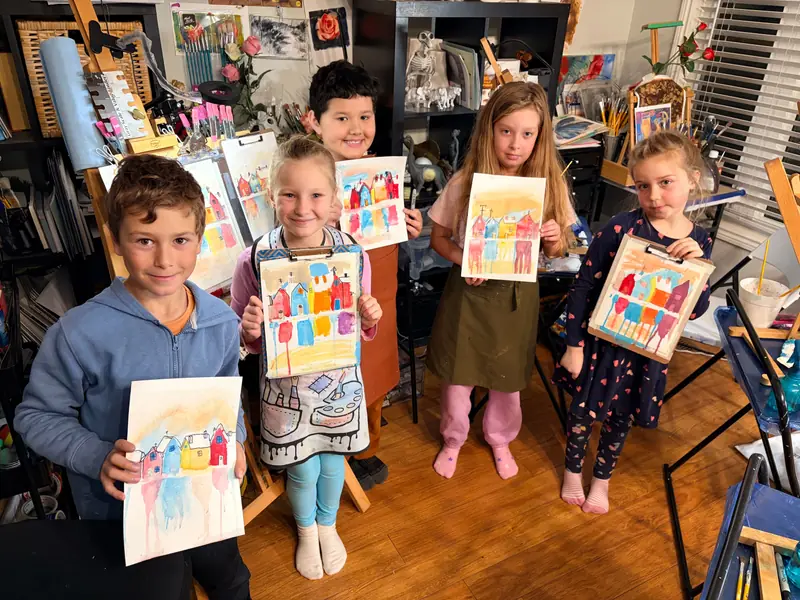
Elena Ant teaches children and teenagers in groups of at most six or one to one, at her studio. Each lesson runs in three stages, each harder than the last, and ends with students stepping back to judge their work.
Ages 7–11
| Class | One class | Five classes |
|---|---|---|
| Group class | $30 | $125 |
| Individual class | $40 | $175 |
Ages 12–18
| Class | One class | Five classes |
|---|---|---|
| Group class | $35 | $150 |
| Individual class | $40 | $175 |
Ask Elena Ant about a place in a class
Tell her which class you are interested in. Groups take at most six students.