Guide · Drawing
Academic drawing: what it is, how the art academies taught it, and what academic art means
Academic drawing is the drawing training of Europe’s art academies: students copied drawings, then drew plaster casts of ancient sculpture, and only then the live model, studying anatomy and perspective along the way. Academic art is art made to the academies’ standards, above all in 19th-century France. Elena Ant teaches academic drawing in London, Ontario: perspective, form, tone, symmetry and composition, drawn from observation.
What is academic drawing?
Academic drawing is the drawing taught at the art academies of Europe: accurate line, proportion, light and tone, learned step by step from copies, plaster casts and the live model.
The Dahesh Museum of Art defines academic art simply as the tradition of drawing, painting and sculpture taught at the academies or art schools of Europe, with rigorous training, historical subjects and polished execution (Dahesh Museum of Art (opens in a new tab)). The academic tradition centred on study from the nude and from classical art (National Gallery, London (opens in a new tab)).
A skull is an academic drawing: it asks for volume, form, light, shadow and tone, and for showing near and far on a flat sheet. One of Elena Ant’s students drew it at eleven, so well that she corrected only a few points.
How did the art academies teach drawing?
In a fixed order: first copying drawings, then drawing plaster casts of ancient sculpture, and only then the live model, with anatomy, geometry and perspective alongside.
Before studying plaster casts or live models, students usually learned to draw by copying two-dimensional images, with the help of drawing courses such as Charles Bargue and Jean-Léon Gérôme’s Drawing Course, first published in 1868 to 1873. Its plates were grouped by parts of the body, so a student could master each one before attempting a whole figure (Dahesh Museum of Art (opens in a new tab)).
At the École des Beaux-Arts in Paris, the teaching was based on the art of ancient Greece and Rome, and anatomy, geometry, perspective and study from the nude were part of the curriculum (Tate (opens in a new tab)). The most promising students competed for the Prix de Rome, an award of three to five years of study in Rome (The Met (opens in a new tab)).
At the Royal Academy in London, students were first admitted as probationers to draw from its casts for several months, and had to submit drawings of casts for approval before moving on to the Life School (Royal Academy of Arts (opens in a new tab)).
What is cast drawing?
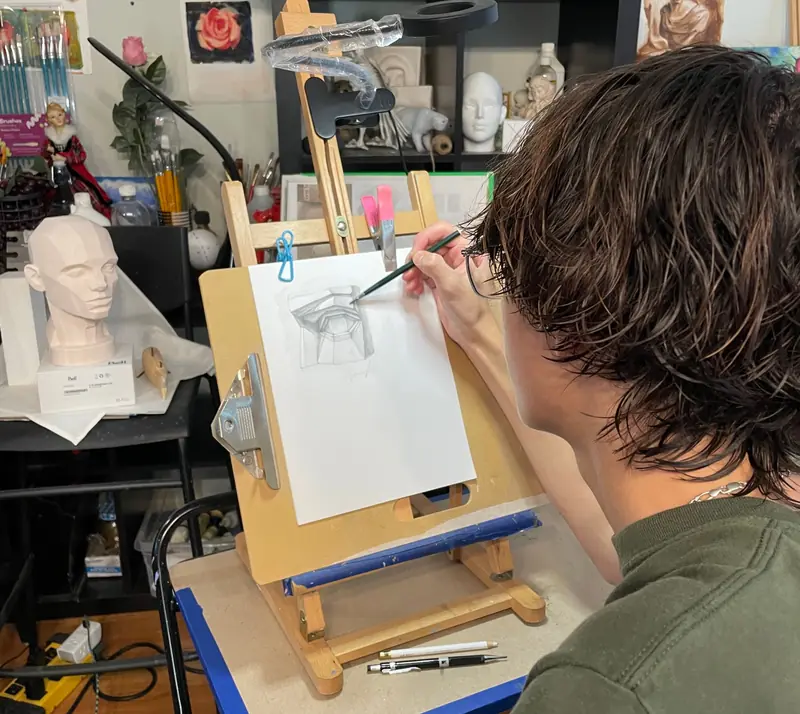
Cast drawing is drawing from plaster casts of sculpture, usually ancient Greek and Roman works. Academy students spent months or years on casts before the live model, learning ideal proportions and the subtle tones of light on a form.
Royal Academy students usually spent at least a year drawing casts before they moved on to life drawing. Most casts were of Greek and Roman sculptures, admired for their combination of naturalism and ideal beauty (Royal Academy of Arts (opens in a new tab)). Collections of casts began in the 17th century to give academy students exemplary models to learn from (Ashmolean Museum (opens in a new tab)).
Drawing a cast means capturing subtle variations in tone across curved surfaces while observing changes in the light, and in drawing casts, students absorbed the ideal proportions of classical anatomy (Pennsylvania Academy of the Fine Arts (opens in a new tab)).
Elena Ant’s studio has shelves of plaster casts.
What is Russian academic drawing?
The drawing tradition of the Imperial Academy of Arts in St Petersburg, founded in 1757, where copying plaster casts was a compulsory stage of training for every artist. Academic drawing is still taught as a subject in the region, for example in Minsk.
The Academy of Three Noble Arts was founded in St Petersburg in 1757, and Catherine the Great proclaimed it the Imperial Academy of Arts in 1764 (Russian Academy of Arts (opens in a new tab)). Copying the “Antiques” was a compulsory stage in the training of artists of every speciality, and the Academy’s cast collection dates back to 1757 (Academy of Arts Museum (opens in a new tab)).
The teacher Pavel Chistyakov combined the traditions of the academic school with direct observation of nature. His students included Repin, Serov and Surikov (Encyclopedia of Saint Petersburg (opens in a new tab)).
In Minsk, the Belarusian State Academy of Arts has had a department of academic drawing since 1957, first headed by a graduate of the St Petersburg Academy of Arts (Belarusian State Academy of Arts (opens in a new tab)).
Elena Ant began studying drawing at nineteen in Minsk, in the studio of the artist Veniamin Marshak, to prepare a portfolio for an art academy. She trained there for fifteen years: drawing first, then tone and technique.
What is academic art?
Academic art is art made to the standards of Europe’s academies, especially the French Academy in the 19th century: classical and historical subjects, idealised figures, careful drawing and a smooth, polished finish.
The Getty defines academic art as conforming to the official standards and principles of taste of European and American art academies (Getty (opens in a new tab)). The French and English academies were established in 1648 and 1768, and their standard was ancient classical art, the European tradition and historical subjects (The Met (opens in a new tab)).
The French Academy ranked history painting above landscapes, portraits, still lifes and scenes of everyday life, and prescribed a smooth surface with no visible brushstrokes (Dahesh Museum of Art (opens in a new tab)). See still life drawing for where still life stood.
Alexandre Cabanel played an important role in teaching at the École des Beaux-Arts and in running the Salon, and his Birth of Venus is a perfect example of the official taste of the period (Musée d’Orsay (opens in a new tab)). William Bouguereau won the Prix de Rome in 1850 and kept his commitment to the tradition’s emphasis on drawing, flawless finish and ideal beauty (Dahesh Museum of Art (opens in a new tab)). Jean-Léon Gérôme was among the most officially honoured French artists of the second half of the 19th century (Getty (opens in a new tab)).
The first Impressionist exhibition attracted 3,500 visitors, against 450,000 at the Salon (The Met (opens in a new tab)). The term academic art later took on the sense of conservative or old-fashioned (Tate (opens in a new tab)), and the Prix de Rome was abolished in 1968 (Tate (opens in a new tab)).
Why learn academic drawing today?
Because it teaches what art, design and animation programmes expect students to bring: perspective, form, tone, symmetry and composition, drawn from observation.
Elena Ant especially wants students preparing for college in art, design or animation to come for academic drawing. She sees many arrive without an understanding of perspective, form, tone, symmetry or composition, and struggle instead of learning.
“I teach students to read fluently. Others arrive at college and only then start learning the alphabet.”
Academic drawing classes in London, Ontario
Elena Ant teaches academic drawing at her studio to teenagers aged 12 to 18 and to students preparing portfolios, in groups of at most six or one to one: perspective, form, tone, symmetry and composition, drawn from observation.
| Class | One class | Five classes |
|---|---|---|
| Group class | $35 | $150 |
| Individual class | $40 | $175 |
Ask Elena Ant about a place in a class
Tell her which class you are interested in. Groups take at most six students.