7–11Group and individual classes for children · London, Ontario
Art classes for kids in London, Ontario, for ages 7 to 11
Elena Ant teaches drawing and painting to children aged 7 to 11, in groups of at most six or one to one, at her studio. Children in a group are of similar age, a few years apart, and each class lasts 45–60 minutes.
| Class | One class | Five classes |
|---|---|---|
| Group class | $30 | $125 |
| Individual class | $40 | $175 |
What children learn
Children learn to draw the way artists do, starting from the first line
Beginners start with line and form: how to see the volume of a sphere or a cube, how the body of an animal is built, how light and shadow fall, and how tones grade from light to dark. Then come composition, mood and the theory of colour.
Each lesson adds something harder, so children learn the logic an artist follows from the first line to the finished picture.
Not only for future artists
What drawing lessons give a child who will never be an artist
Some parents bring their children so they are busy with something other than computer games, and so they learn art from an early age. What children take away is a skill and the habits that come with it: looking closely, judging their own work from a distance, and sticking with something hard. An OECD review of arts education concluded that these, not higher marks in other subjects, are the main reason to learn art (Winner et al., 2013 (opens in a new tab)).
Drawing can also lift a child’s mood. In experiments with children aged 6 to 12, a few minutes of drawing after a disappointment helped, most of all when they drew something else (Drake and Winner, 2013 (opens in a new tab)).
The benefits of art for kids: what research shows, and what it doesn’t
How a lesson runs
Every lesson runs in three stages, each harder than the last
- 1
She demonstrates each stage at her own easel.
A lesson runs in three stages, each about a third of the class and each harder than the last: a linear drawing first, then volume, then composition.
- 2
She checks every student’s work after each stage.
She corrects and points out errors, students fix them, and the next stage begins. In a group, each student still works at their own level.
- 3
Students step back to judge their work.
From a metre and a half to two metres away, students look at their own work. She comments on it, and always encourages.
When the class draws from a reference, Elena Ant offers three or four to choose from. The younger group loves to choose: they vote, the majority wins, and she promises the others a lesson on their choice.
“I love it when my students help choose what we draw.”
Joining a group that has already started: individual classes first
A group has often been studying together for six months or more, and a newcomer would find it hard to keep up. So Elena Ant suggests starting with individual classes.
The child gets used to her as a teacher, understands the tasks, learns to concentrate, and loses the nervousness and self-criticism, so they work in a creative state.
Individual classes for ages 7–11: $40 a class, or $175 for five.
Encouragement, not criticism
Elena Ant never criticises a child’s drawing, and asks parents not to
Young artists are very sensitive to criticism, and every stage of their development matters. At the end of each lesson she comments on the work, and always praises and encourages.
Parents often ask how their child is progressing. Her advice is not to judge too early: some children cannot yet hold a pencil or a brush properly but already show feeling and understanding in what they draw. Skill is trained like a sport, through repetition.
“The hand obeys the artist. What matters most is reaching the point where the student understands the task and the hand carries it out.”
Paintings by children in Elena Ant’s studio
Butterfly · ages 7–11
Halloween cats
A bumblebee
A winter forest under the moon
A cat behind a wall
Penguin
A dog under the moon
Halloween monsters
Panda
A bug with a lantern
Winter houses with lights
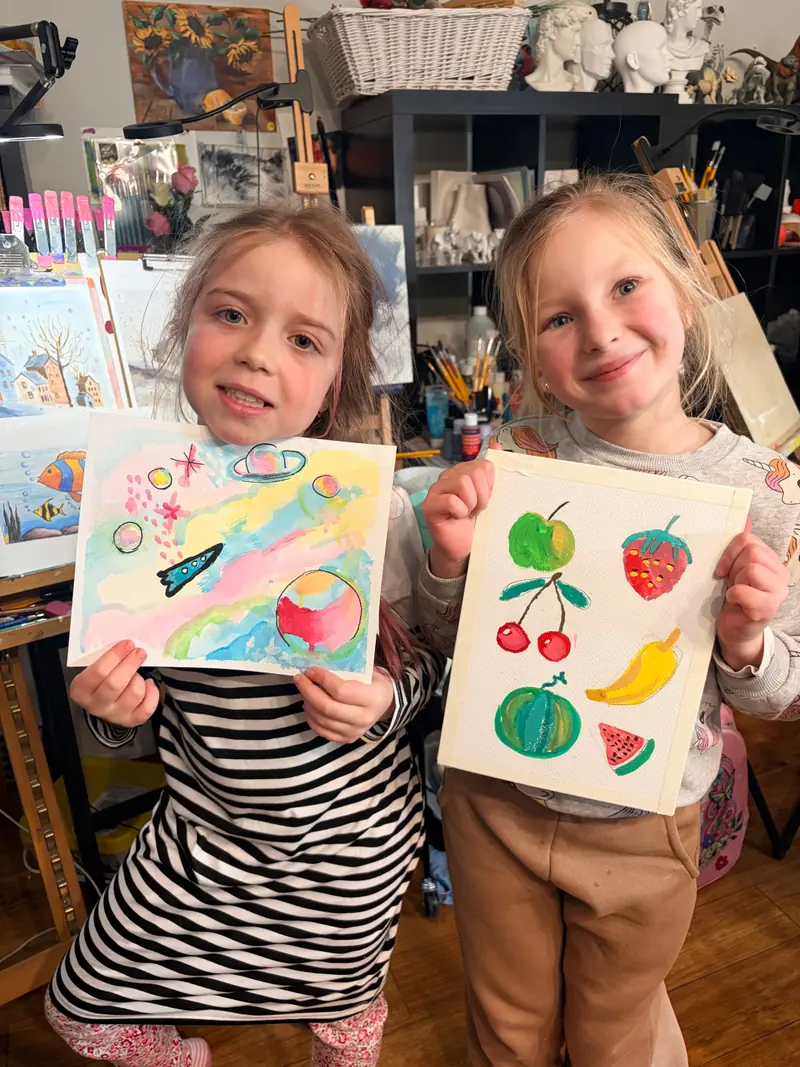
A group with their paintings
Orcas
Kittens in coloured pencil
Mid-lesson, at the palette
Mixing colour
Where classes are held, what to bring, and missed classes
- Where
- A dedicated studio at 31 Parkside Cres, London, Ontario.
- Materials
- Students bring their own: pencils, charcoal, gouache and oil paints, and a practice canvas or a stretched canvas for a final piece.
- A missed class
- With notice, a student can join the class live on Zoom from home. With at least a few days’ notice, a missed class is not charged; notice on the last day or the day before is charged, with the class offered on Zoom. Lessons are usually recorded, so a student who was ill can watch and repeat it at home.
Next steps: art classes for teens, ages 12 to 18, every price and how to enquire.
Testimonials for Elena Ant’s art classes in London, Ontario
Reviews on Google Maps (opens in a new tab)My kids are having the best time with Elena! She is very knowledgeable, great with kids, and knows how to bring out the creativity in everyone. We’re so happy with the experience!
Anastasia · Google review Our son has been attending Elena Ant Art Studio for a long time, more than 4 years, and we’ve seen great progress in his artistic skills. Art has become a hobby he truly enjoys, and the classes and workshops have helped him develop his creativity. We’re very happy with his experience and with our decorated walls, and would highly recommend the studio!
Art U · Google review My daughter and I absolutely love taking art classes with Elena! She is so patient and accommodating, and we really appreciate that she makes classes enjoyable for both of us. We’ve enjoyed both in-person and online classes, and I also had a wonderful experience at her masterclass. Sharing a couple of our creations!
Nadezda K · Google review I’ve joined Elena’s masterclasses a few times and absolutely love them! Honestly, this lady could teach a potato to draw a masterpiece! My son loves her classes too and comes home with the most beautiful artwork every time. She’s got some serious magic in those hands!
Irina D · Google review Greatest master classes! Very friendly teacher and cozy studio. I have learned so much from Elena’s art classes!
Curtis C. · Google review
Ask Elena Ant about a place in a class
Tell her which class you are interested in. Groups take at most six students.