Guide · Drawing
Charcoal drawing for beginners: what charcoal is, and how to draw with it
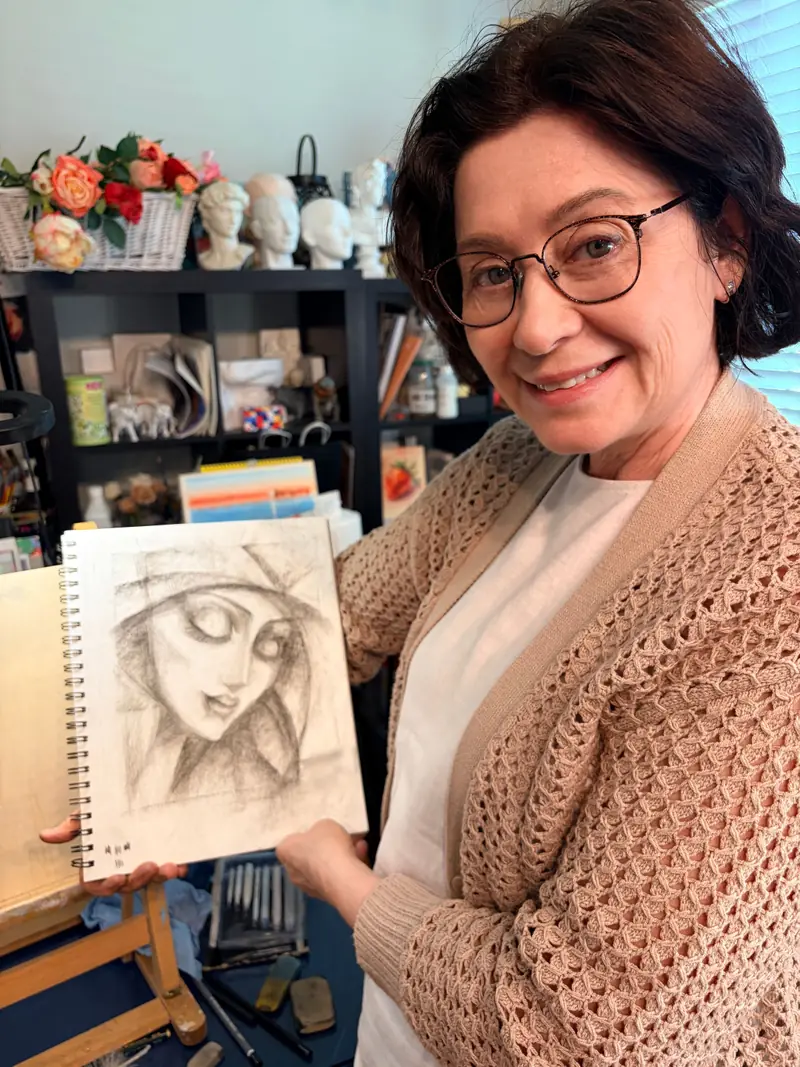
Charcoal is a black, crumbly drawing material made of carbon, usually from willow or vine twigs heated without oxygen. Charcoal drawing gives soft, dense lines that blend with a finger or a cloth and lift off with an eraser, so it suits broad, quick studies, but it smudges until it is fixed or framed under glass. Elena Ant’s students in London, Ontario, draw with charcoal as well as pencil.
What is charcoal drawing?
Charcoal drawing is drawing with charcoal, a black, crumbly material made of carbon. Artists use it for sketches, for the underdrawing of paintings, and for finished drawings.
The Tate describes charcoal as a black crumbly drawing material made of carbon, often used for sketching and underdrawing for paintings, and for more finished drawings. It is traditionally made from thin, peeled willow twigs heated without oxygen (Tate (opens in a new tab)).
Charcoal is one of the oldest drawing materials (Britannica (opens in a new tab)). In the Chauvet-Pont d’Arc cave in France, the black drawings are made with charcoal, and radiocarbon dates place nearly all of them in the cave’s oldest period of human use, between about 37,000 and 33,500 years ago (Quiles et al., 2016 (opens in a new tab)).
Since the Renaissance, artists have used charcoal to develop ideas, outlines and shadows before painting (The Met (opens in a new tab)). Leonardo da Vinci’s Burlington House Cartoon, from about 1506 to 1508, is drawn in charcoal with white chalk (National Gallery, London (opens in a new tab)). Charcoal was once much used in all academies and workshops for quick sketches and studies of models (Britannica (opens in a new tab)).
What are the types of charcoal for drawing?
Willow or vine charcoal, compressed charcoal, and charcoal pencils. Willow and vine sticks are soft and easy to rub away; compressed charcoal is harder and darker; charcoal pencils are cleaner but less versatile.
Drawing charcoal comes as charred twigs, usually willow or vine, or as sticks of compressed charcoal (Getty (opens in a new tab)).
Willow or vine charcoal is soft yet brittle and can be rubbed away, but its range is limited in the darker values (MIT Arts (opens in a new tab)).
Compressed charcoal is powdered charcoal pressed again into sticks of different hardness, for a wider range of dark greys and blacks (The Met (opens in a new tab)). Its lines smear less than stick charcoal’s, but are still fixed to stop smudging (MFA Boston (opens in a new tab)).
Charcoal pencils hold finely ground, highly compacted charcoal. They are less messy than charcoal sticks, but not as versatile (Getty (opens in a new tab)).
How do you draw with charcoal?
Use the point for lines and the side for broad tone, blend with a finger, a cloth or a stump, and lift out highlights with a kneaded eraser. Work on paper with some texture, which holds the charcoal.
A charcoal point gives hair-thin lines, and charcoal used on its side gives evenly toned areas. Rubbing the line gives soft, intermediate shades (Britannica (opens in a new tab)). A charcoal line is dense where it is pressed and powdery at the edges, less precise than a hard graphite pencil, so charcoal suits freer studies (Tate (opens in a new tab)).
Stick charcoal contains no binder, so it moves easily: broad masses can be spread with a finger, a chamois cloth or a cork, and highlights and corrections lifted out with a kneaded eraser (The Met (opens in a new tab)). A stump, also called a tortillon, is a tight roll of leather, paper or felt used to blend charcoal (Getty (opens in a new tab)).
Charcoal needs paper with some texture to hold it (The Met (opens in a new tab)). Charcoal paper is soft, with a moderately rough grain (Getty (opens in a new tab)), and cheap newsprint is good for practice sketches (MIT Arts (opens in a new tab)).
In Elena Ant’s classes, students draw with pencils and charcoal, and paint with gouache and oil. Beginners start from line and form, and from light and shadow.
Why is charcoal a limited drawing medium?
Because unless it is fixed, charcoal is impermanent: it smudges and rubs off easily. Its soft edge also suits broad drawing more than precise lines, and it comes only in dark greys and black.
Britannica describes charcoal as impermanent, easily erased or smudged, unless it is fixed with a gum or resin, and as favouring broad, vigorous drawing, with an emphasis on mass and movement rather than on precise lines (Britannica (opens in a new tab)).
Conservators find charcoal and pastel the most friable of drawing media, the most easily rubbed off (American Institute for Conservation (opens in a new tab)). Charcoal is always dark grey to black (The Met (opens in a new tab)).
Should you use fixative on a charcoal drawing?
Many artists spray finished charcoal drawings with fixative to stop smudging. Fixative binds the charcoal to the paper, but it can darken the drawing, so conservators do not recommend it as a treatment.
Many artists apply fixative to finished drawings to prevent smudging (The Met (opens in a new tab)). Fixative physically binds a powdery material such as charcoal to the paper, but over time it can change the gloss, darken, crack and become insoluble (MFA Boston (opens in a new tab)). As a conservation treatment for drawings, conservators generally do not recommend fixative (American Institute for Conservation (opens in a new tab)).
A workable fixative lets you keep drawing: Krylon says you can erase through its Workable Fixatif to rework a drawing (Krylon (opens in a new tab)).
Lay the drawing flat and spray from about 30 cm away, in a steady back-and-forth motion (Daler-Rowney (opens in a new tab)). Spray only outdoors or in a well-ventilated room, as the safety data sheet for Krylon’s Workable Fixatif directs (Krylon (opens in a new tab)).
How do you protect and frame a charcoal drawing?
Mat and frame it under glass, with the mat keeping the drawing off the glass. Keep it out of plastic sleeves and plastic glazing, whose static charge can pull charcoal off the paper.
The Canadian Conservation Institute advises that charcoal artworks in good condition be matted and framed, and notes that a window mat keeps space between the image and the glazing (Canadian Conservation Institute (opens in a new tab)). A framed work should never touch its glazing (Canadian Conservation Institute (opens in a new tab)).
Glass picks up very little static, so the Institute recommends it for charcoal and other loosely bound media; plastic glazing is not recommended, because its static charge can lift particles from the drawing (Canadian Conservation Institute (opens in a new tab)).
For the same reason, do not keep a charcoal drawing in a plastic sleeve or folder. If it cannot be framed, interleave it with acid-free tissue, and to move it, slide a stiff paper or mat board underneath (Canadian Conservation Institute (opens in a new tab)).
Charcoal and pencil drawing classes in London, Ontario
Elena Ant teaches drawing from the basics at her studio, in groups of at most six or one to one, to adults, teenagers and children from age seven. Classes use pencils, charcoal, gouache and oil. How to learn to draw
| Class | One class | Five classes |
|---|---|---|
| Group class | $40 | $175 |
| Individual class | $45 | $200 |
Ask Elena Ant about a place in a class
Tell her which class you are interested in. Groups take at most six students.