Guide · Drawing
Shading techniques: hatching, cross-hatching, stippling and blending, and how to use a value scale
Shading is the darkening of parts of a drawing to show shadow, so that flat marks read as form and light. The main shading techniques are hatching (parallel lines), cross-hatching (layers of lines at new angles), stippling (dots) and blending (rubbing the marks with a stump). A value scale, from white to black, helps you judge how dark each area should be. Elena Ant’s students in London, Ontario, learn how tones grade from light to dark from their first lessons.
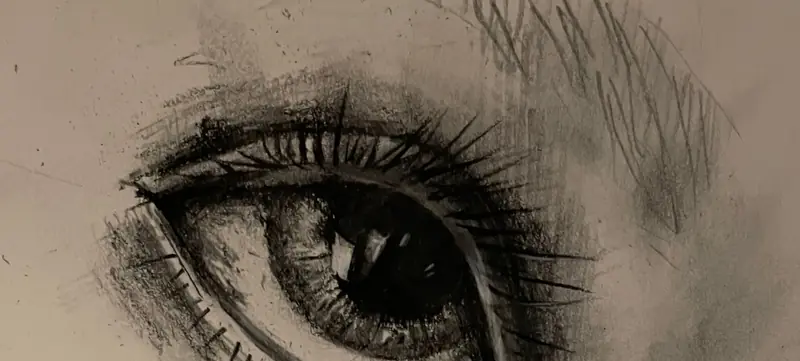
What is shading in art?
Shading is the darkening of areas of a picture to show shadow. In a drawing, the spread of values from light to dark is what makes a form look three-dimensional.
The Getty’s Art & Architecture Thesaurus defines shading as the darkening of areas of a picture to indicate shadows (Getty (opens in a new tab)). Value is the degree of lightness to darkness (Palomar College (opens in a new tab)).
Elena Ant’s beginners learn how light and shadow fall and how tones grade from light to dark, starting with the volume of a sphere and a cube.
What is a value scale, and how do you make one?
A value scale is a row of tones that steps evenly from white to black. The standard scale has nine values: white, black and seven greys between them. Make the two ends first, then the middle grey, then fill in the steps between.
The standard value scale consists of nine values, from white to black with seven greys in between. A step scale moves from white to black in equal steps; a gradient scale moves seamlessly (Palomar College (opens in a new tab)).
To make one, divide a strip into nine sections. Make the darkest dark and the lightest light first, then a middle grey halfway between them, then the steps in between, and adjust any jumps between neighbouring tones (Palomar College (opens in a new tab)).
In pencil, a five-step scale can use an HB for the lightest grey, a B or 2B for the middle, and a 4B or 6B for the darkest (BYU-Idaho (opens in a new tab)). Hold the finished scale up to a still life to compare how light or dark each object is with your drawing (Palomar College (opens in a new tab)).
What are hatching and cross-hatching?
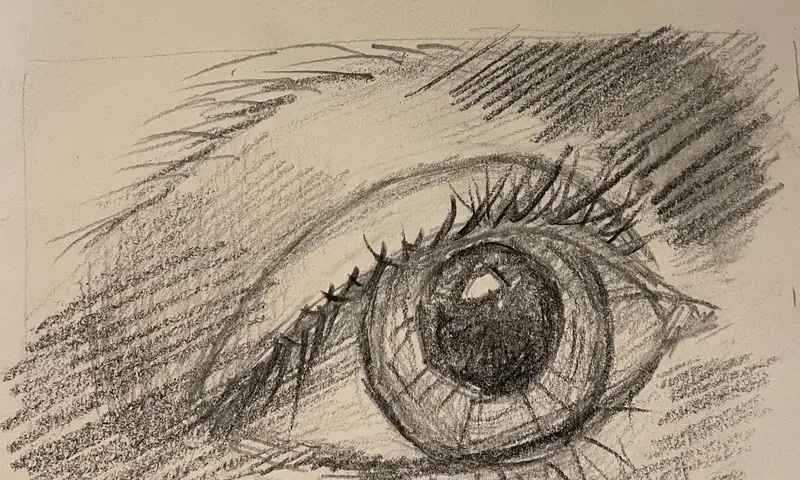
Hatching is shading with fine, closely laid parallel lines. Cross-hatching lays a second set of lines over the first at a different angle, for a darker tone. Closer lines, or more layers, make a darker value.
Hatching is shading or modelling with fine, closely laid parallel lines (Getty (opens in a new tab)). A hatching line can be straight or curved, or vary in thickness (DeRoche, 2022 (opens in a new tab)).
In cross-hatching, one set of hatching is drawn over another at a different angle, making a network of lines and a darker value (Getty (opens in a new tab)). Each new layer’s lines cover openings left by the layer before (Palomar College (opens in a new tab)). In cross-contour hatching, the lines run across the form rather than along its edge (Getty (opens in a new tab)).
Engravers built whole pictures this way. Martin Schongauer used cross-hatching in the deepest shadows to model forms, and the fine lines of Albrecht Dürer’s engraving Adam and Eve create form, texture and shading at once (The Met (opens in a new tab)).
What is stippling in drawing?
Stippling is shading with small dots: the closer together the dots, the darker the value.
Stippling is marking a surface with small flicks or dots (Getty (opens in a new tab)). The farther apart the dots, the lighter the value looks, and the closer together, the darker (Palomar College (opens in a new tab)).
Francesco Bartolozzi, one of the foremost practitioners of stipple engraving, used it to reproduce a red chalk drawing by Leonardo da Vinci: printed, the image is made of dots (V&A (opens in a new tab)).
How do you blend shading with a blending stump?
A blending stump is a stick of tightly rolled paper, pointed at both ends, used to smudge pencil, charcoal or pastel; a tortillon is a smaller one, pointed at one end. Blend near the end of a drawing, not all over it.
Stumps are tapered at both ends and made of tightly rolled paper, and their tips can be sharpened with sandpaper; tortillons are made the same way but pointed at one end only (DeRoche, 2022 (opens in a new tab)). The Getty describes tortillons as small stumps of tightly rolled grey or white paper (Getty (opens in a new tab)).
A stump is the best way to blend shading in tight spaces, and blending gives a drawing a softer feel. Fingers can leave oil or dirt on the paper (DeRoche, 2022 (opens in a new tab)).
Wait until a drawing is about 90% complete before smudging, and do not blend everything: if every surface is smooth, the drawing looks flat and lifeless (Palomar College (opens in a new tab)). Charcoal blends especially easily; see charcoal drawing.
Which pencils are best for shading?
A few grades: H pencils are hard and make light marks, B pencils are soft and make dark ones, and HB is in between. For beginners, an HB, a 2B and a 4B cover most shading.
The more clay in a pencil lead, the harder the pencil; the more graphite, the softer and blacker. B stands for black and H for hard, and a higher number means a harder or softer lead (Staedtler (opens in a new tab)). An HB is half clay and half graphite (Derwent (opens in a new tab)).
Grades were never standardised internationally, so they vary from one maker to another (Faber-Castell (opens in a new tab)). For beginners, HB, 2B and 4B pencils are quite handy (Palomar College (opens in a new tab)).
The harder the pencil, the lighter the mark. To go darker, change to a softer pencil rather than pressing harder, which only dents the paper and makes erasing difficult (DeRoche, 2022 (opens in a new tab)).
How do you shade a sphere?
Draw the circle lightly, decide where the light comes from, then shade from light to dark: the highlight, greys darkening away from the light, the shadow side, and a cast shadow beneath, darkest closest to the sphere.
Start with a lightly drawn circle, and add shading once the circle looks correct. Don’t forget the shadow under the sphere: without it, the sphere appears suspended in space (DeRoche, 2022 (opens in a new tab)).
A highlight marks where the light is reflected most directly, and the further from it, the darker the grey. Where the shadow side begins, the tone darkens more suddenly, but the dark side does not turn solid black. The part of the cast shadow closest to the object is usually the darkest (University of Evansville (opens in a new tab)).
Build up from light to dark: light greys with a 4H pencil, the middle greys with an HB, and the darkest areas with a 4B (DeRoche, 2022 (opens in a new tab)). Judge each shadow against the darkest dark in the drawing (Palomar College (opens in a new tab)). For the names of the parts of light and shadow, see still life drawing.
How do you shade on toned paper?
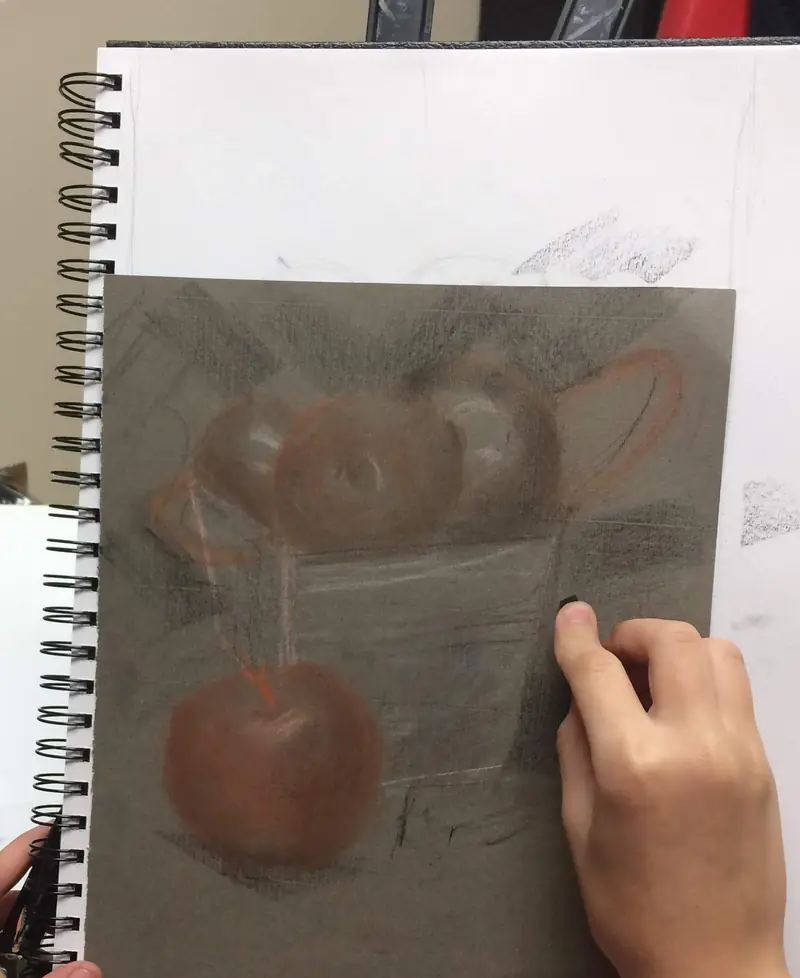
On toned paper, the paper is the middle tone: you draw the darks and add the lights in white, a technique called heightening.
Heightening completes the forms by raising the value of the right areas with white or a pale colour (Getty (opens in a new tab)). Draftsmen added touches of white chalk, which work especially well on toned or coloured paper (The Met (opens in a new tab)). As a middle tone, blue paper let artists model forms easily in light and dark (Getty (opens in a new tab)).
What are common shading mistakes?
Blending everything smooth, pressing harder instead of changing to a softer pencil, leaving out the cast shadow, and finishing one area at a time.
A drawing where every surface is smooth looks flat (Palomar College (opens in a new tab)). Pressing harder only dents the paper; a softer pencil goes darker (DeRoche, 2022 (opens in a new tab)). Without its cast shadow, a sphere seems to float (DeRoche, 2022 (opens in a new tab)). And working one area to a finish before the rest is best avoided: develop the whole drawing at the same rate (DeRoche, 2022 (opens in a new tab)).
Learn to shade in drawing classes in London, Ontario
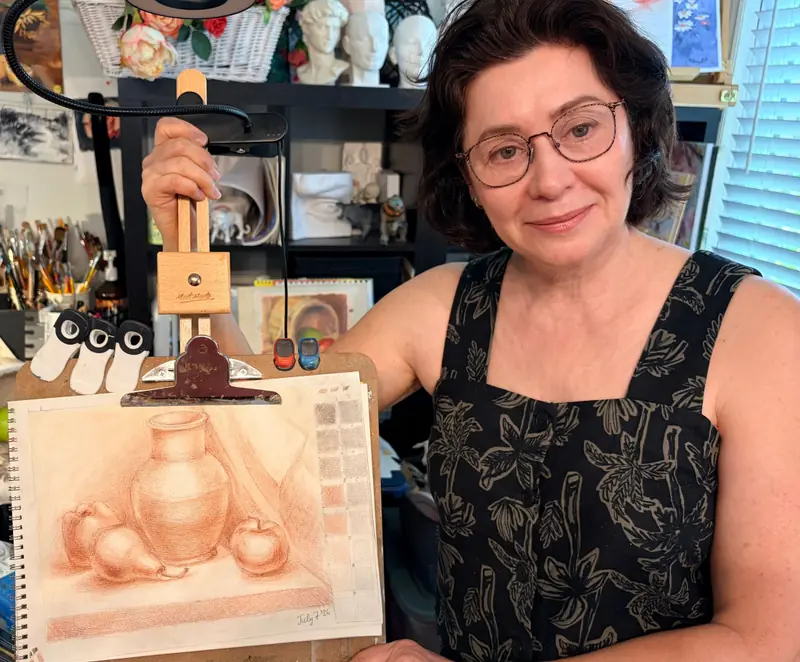
Elena Ant teaches drawing from the basics at her studio, in groups of at most six or one to one, to adults, teenagers and children from age seven: line and form, light and shadow, and tones from light to dark. How to learn to draw
| Class | One class | Five classes |
|---|---|---|
| Group class | $40 | $175 |
| Individual class | $45 | $200 |
Ask Elena Ant about a place in a class
Tell her which class you are interested in. Groups take at most six students.