Guide · Drawing
Perspective drawing: how one-point and two-point perspective work
Perspective drawing creates depth on a flat page with lines. Edges that run away from you, though parallel, are drawn meeting at a vanishing point on the horizon line, which is always at your eye level. One-point perspective uses one vanishing point, for a box or a street seen face-on; two-point perspective uses two, for a box or a building seen from its corner.
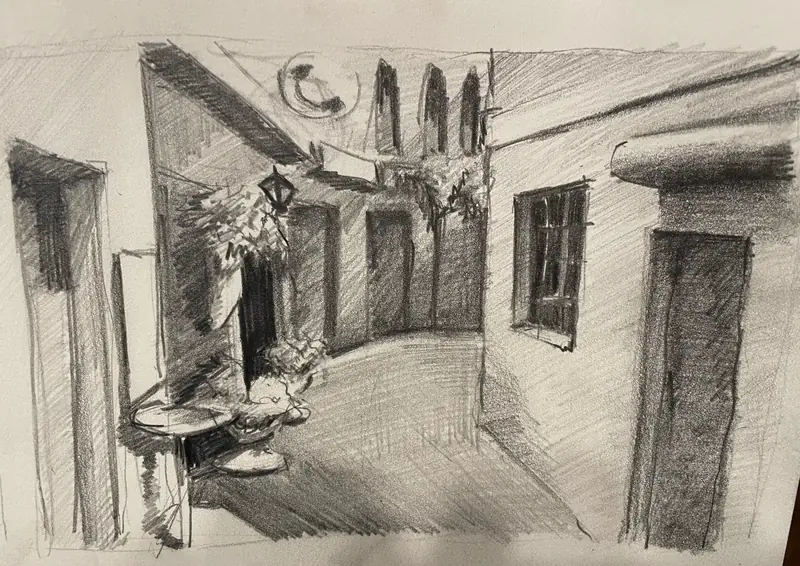
What is perspective drawing?
Perspective drawing, or linear perspective, is a way of building a convincing impression of three-dimensional space on a flat surface with lines that recede to vanishing points.
The National Gallery in London defines perspective as a means of constructing a convincing impression of three-dimensional space on a two-dimensional surface. Linear perspective does it mainly with line (National Gallery, London (opens in a new tab)).
Aerial perspective, also called atmospheric perspective, is a different method: it shows distance through tone and colour (National Gallery, London (opens in a new tab)), because a landscape’s colours and tones change with the atmosphere as it recedes from the viewer (National Gallery, London (opens in a new tab)). Distant mountains take on a bluish cast, and distant objects look somewhat lighter, with less contrast between light and shade (Britannica (opens in a new tab)).
What are the horizon line and the vanishing point?
The horizon line is your eye level. A vanishing point is the point on it where receding parallel lines appear to meet.
The horizon line is always at eye level, and looking down does not move it: your eye level stays at the height of your eyes (University of Evansville (opens in a new tab)). In a landscape, the horizon line is the height of your eye off the ground, not the line of distant mountains (DeRoche, 2022 (opens in a new tab)).
A vanishing point is where all receding parallel lines meet, and the point in a picture that should look furthest from the viewer (National Gallery, London (opens in a new tab)).
Where an object sits against the horizon line decides what you see of it. An object above your eye level is seen from underneath, and an object below it shows its top (University of Evansville (opens in a new tab)).
What is one-point perspective?
One-point perspective uses a single vanishing point. It works when you face the scene square-on: looking straight down a road or a hallway, or at the front of a box.
One-point perspective works only when every surface faces you square-on or runs straight away from you, as when you look straight down a road or a hallway (DeRoche, 2022 (opens in a new tab)). Used for an object turned at an angle, it distorts (University of Evansville (opens in a new tab)).
To draw a box in one-point perspective, draw the horizon line and mark a vanishing point on it. Draw the front of the box as a square or rectangle, then draw lines from its corners to the vanishing point to give it depth (University of Evansville (opens in a new tab)). Every line in the drawing is vertical, horizontal, or runs to the vanishing point (DeRoche, 2022 (opens in a new tab)).
What is two-point perspective?
Two-point perspective uses two vanishing points on the horizon line. It is for an object seen from its corner, such as a box or a building turned at an angle to you.
When you look at an object’s corner rather than square-on at one of its faces, two-point perspective is the system to use. Its vertical edges stay vertical, at a right angle to the horizon line (University of Evansville (opens in a new tab)).
To draw a box in two-point perspective, start with a vertical line, its nearest edge, and two vanishing points on the horizon line. Draw lines from the top and bottom of that edge to each vanishing point: they make the top and bottom edges of the box. Two more vertical lines, one to the left and one to the right, set its depth and length (University of Illinois (opens in a new tab)).
Vanishing points placed too close together make the angles steeper than they would look in real life, and often the vanishing points belong far outside the edges of the drawing (DeRoche, 2022 (opens in a new tab)).
What is three-point perspective?
Three-point perspective adds a third vanishing point above or below the horizon line, for extreme heights and depths: looking up at a tall building, or down on a scene from above.
Looking up at a tall building from below is called a worm’s-eye view: its edges recede to two vanishing points, and its verticals recede upward to a third. Looking down on an object in three-point perspective is called a bird’s-eye view (University of Evansville (opens in a new tab)).
Who invented perspective drawing?
Linear perspective was developed in Florence in the early 1400s. Filippo Brunelleschi demonstrated it with two painted panels, and Leon Battista Alberti described it in his treatise On Painting in 1435.
The Met dates to 1413 Brunelleschi’s two experimental panels, now lost, which showed the Palazzo della Signoria and the Baptistery in Florence (The Met (opens in a new tab)).
Alberti’s treatise On Painting (De pictura, 1435) described the system, in which receding parallel lines appear to meet at a single point on the horizon (National Gallery, London (opens in a new tab)).
Masaccio was the first Renaissance painter to use Brunelleschi’s linear perspective, in his fresco of the Holy Trinity, painted about 1427 in the church of Santa Maria Novella in Florence (Smarthistory (opens in a new tab)).
Do art schools ask for perspective drawings in a portfolio?
Some Ontario programmes do. Sheridan College’s sample portfolio for its Bachelor of Animation includes perspective line drawings, and Seneca Polytechnic asks Animation applicants for a room in two-point perspective.
Sheridan’s sample portfolio sheet for its Bachelor of Animation calls perspective drawing a critical skill in animation, and asks for drawings that translate 3D space onto a 2D surface (Sheridan College (opens in a new tab)).
For its Bachelor of Illustration, Sheridan asks for drawings that include buildings or cars, drawn freehand, without a ruler or any digital help with perspective (Sheridan College (opens in a new tab)).
Seneca Polytechnic’s Animation portfolio includes a two-point perspective view of a room in the applicant’s home (Seneca Polytechnic (opens in a new tab)).
Elena Ant teaches perspective to teenagers in her academic drawing classes, with form, tone, symmetry and composition, drawn from observation. She sees many students arrive at college without these skills.
Perspective in academic drawing classes for teens in London, Ontario
Elena Ant teaches teenagers aged 12 to 18 at her studio, in groups of at most six or one to one: perspective, form, tone, symmetry and composition, drawn from observation.
| Class | One class | Five classes |
|---|---|---|
| Group class | $35 | $150 |
| Individual class | $40 | $175 |
Ask Elena Ant about a place in a class
Tell her which class you are interested in. Groups take at most six students.