Guide · Drawing
Observational drawing: what it is, and exercises to practise drawing from life
Observational drawing is drawing a real subject while you look at it, rather than from memory, imagination or a photograph. It is practised with a few classic exercises, such as contour, blind contour, gesture and negative-space drawing, and it is what many art schools ask to see in a portfolio. Elena Ant teaches drawing from observation in London, Ontario: her students draw still lifes from life under a directed light.
What is observational drawing?
Observational drawing is drawing a real, three-dimensional subject while looking at it, and putting down accurately what you see rather than what you know or remember.
Researchers define observational drawing as the freehand, accurate depiction of three-dimensional objects observed directly, which demands close visual analysis and translating what the eye sees into the movement of the hand (Safai et al., 2026 (opens in a new tab)).
A teaching textbook from Palomar College calls it the practised skill of paying attention to the subject in front of you (Palomar College (opens in a new tab)), and advises against drawing from memory or from what you think objects should look like: draw what you see (Palomar College (opens in a new tab)).
What are the best observational drawing exercises?
Contour drawing, blind contour drawing, gesture drawing and negative-space drawing. Each trains a different part of looking: edges, hand–eye coordination, movement, and the shapes between things.
Contour lines define the outline of a form and its interior structure, without shading. A blind contour drawing is one continuous line, drawn while looking only at the subject, never at the paper; in a modified contour drawing, the artist looks at the subject about 90% of the time (Palomar College (opens in a new tab)). The Getty defines blind contour drawing as drawing the contours of an object while looking at the object and not at the drawing (Getty (opens in a new tab)).
A gesture drawing is made quickly and energetically, usually in an almost continuous line. Two minutes is a typical length, and timed drills can start with gestures of just 15 seconds (Palomar College (opens in a new tab)).
In negative-space drawing, you draw the shapes around and between parts of the subject instead of the subject itself: if the subject is drawn correctly, those shapes look correct too (DeRoche, 2022 (opens in a new tab)).
Ontario’s Grades 1 to 8 arts curriculum (revised 2009) asks Grade 4 students to make contour drawings of overlapping, easily recognisable objects, such as a piece of fruit, a shoe, a glove or a pitcher, from different points of view (Ontario Ministry of Education (opens in a new tab)).
How do you draw from observation?
Frame the subject with a viewfinder, lay in light organising lines, check verticals with plumb lines and sizes against one another, and keep comparing your drawing with the subject as you go.
A viewfinder is a frame with an open window, usually a piece of card with a window cut in the middle, for choosing what to draw. Organisational lines are light preliminary marks that serve as the scaffolding of a drawing, and plumb lines are vertical lines drawn through the centre of a form to check whether it stands straight or at an angle. To get proportions right, see how many times a smaller measurement goes into a larger one (Palomar College (opens in a new tab)).
Compare your drawing with the subject continually while you draw, and trust your eye over what your brain tells you the subject looks like (DeRoche, 2022 (opens in a new tab)). For measuring with a pencil held at arm’s length, see still life drawing.
Why draw from life instead of from a photograph?
A photograph gives you less information than your eyes do, and it has already flattened the subject into two dimensions, which is the very step that drawing from life trains. Many art schools ask for drawing from life.
A 2013 teaching report from Saint Louis University notes that drawing professors generally discourage drawing from photographs, because a photo gives less information than your eyes can see and drawings from photographs often look flat. Working only from photographs lets the camera do the hard work of turning three-dimensional forms into two-dimensional shapes (Saint Louis University (opens in a new tab)).
OCAD University prefers drawing from direct observation to drawing from photographs in Illustration portfolios (OCAD University (opens in a new tab)). See how to make an art portfolio.
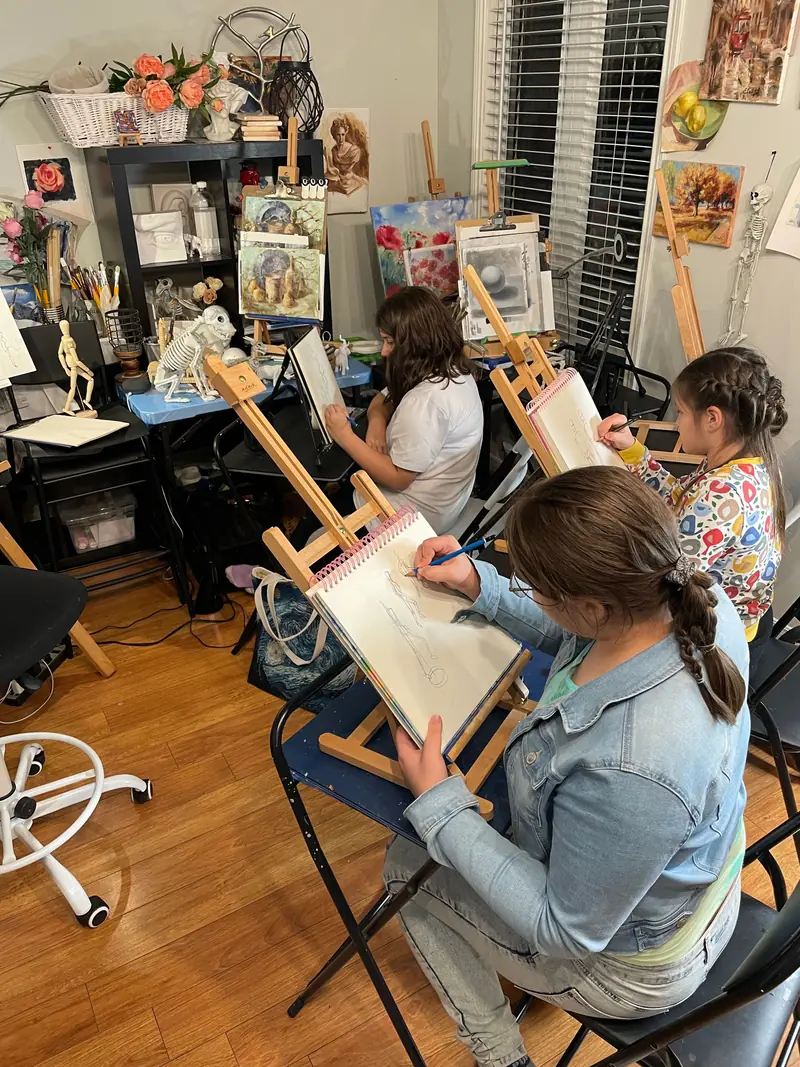
Elena Ant sets still lifes under a directed light for drawing from life, and offers references for some linear drawings, such as animal figures.
What are famous examples of observational drawing?
Leonardo da Vinci drew animals from life, Albrecht Dürer made detailed studies of a hare and a piece of turf, and John Constable painted dozens of studies of clouds outdoors.
The Royal Collection notes that Leonardo da Vinci’s drawings of cats appear to have been studied directly from life (Royal Collection Trust (opens in a new tab)), and the Met says he probably drew his study of a bear walking from life (The Met (opens in a new tab)).
Albrecht Dürer’s Great Piece of Turf, Young Hare and Wing of a Blue Roller are his most famous nature studies. The Albertina in Vienna says Dürer captured what he meticulously observed just as painstakingly on paper or parchment, and that these are not preliminary studies but works in their own right (Albertina (opens in a new tab)).
John Constable made over one hundred sketches of the sky outdoors, an exercise he called skying (Yale Center for British Art (opens in a new tab)). By October 1822 he wrote that he had made “about 50 carefull studies of skies tolerably large” (V&A (opens in a new tab)).
Is observational drawing good for children?
Ontario’s arts curriculum has children in Grade 2 draw trees from observation, and in a study of children aged 5 to 8, a short drawing programme made their drawings of a plant more accurate.
In Grade 2, Ontario’s curriculum has children draw trees based on observations of real trees (Ontario Ministry of Education (opens in a new tab)).
In three connected studies of 5- to 8-year-olds drawing a plant, children’s drawings after a brief “Draw like a scientist” programme were more accurate in the size, shape, scale and orientation of the plant’s parts, with only a slight loss of accuracy ten weeks later (Preston et al., 2025 (opens in a new tab)).
Elena Ant teaches children from age seven. Beginners start with line and form: how to see the volume of a sphere or a cube, and how light and shadow fall.
Drawing from life in London, Ontario
Elena Ant teaches drawing from observation at her studio, in groups of at most six or one to one, to adults, teenagers and children from age seven. How to learn to draw
| Class | One class | Five classes |
|---|---|---|
| Group class | $40 | $175 |
| Individual class | $45 | $200 |
Ask Elena Ant about a place in a class
Tell her which class you are interested in. Groups take at most six students.